

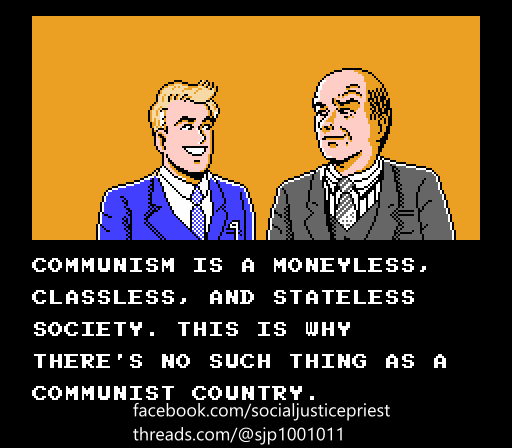
With income inequality continuing to grow and the election of Mayor Mamdani in NYC, we’re hearing more people talk about capitalism, socialism, and communism [1][2]. Unfortunately for us, however, few people talking about these economic systems seem to understand what they are. To provide some clear definitions, I will be writing an article about each one. The articles will describe what they are, what they’re not, how I feel about them. My previous articles covered capitalism and socialism. This article will be about communism.
What is communism?
Communism is a little different from the previous two words I discussed. First, it’s not just an economic system. Communism is form of social organization. Second, its definition changes whether you’re talking about “communism (little ‘c’)” as a system or “Communism (big ‘C’)” as a form of government. This is important because they have two different, and opposing, definitions (more on this later). Let’s start with communism. According to the dictionary, communism is “a theory or system of social organization based on the holding of all property in common, actual ownership being ascribed to the community as a whole or to the state” [3]. To expand on this further, communism is a moneyless, classless and stateless society [4][5]. When Marx and Engels wrote about communism, this is what they meant. When left-wingers talk about “communism,” this is what they mean.
Okay, then what is Communism?
According to the dictionary, Communism is a form of government where “(often initial capital letter) a system of social organization in which all economic and social activity is controlled by a totalitarian state dominated by a single and self-perpetuating political party” [3]. This is the exact opposite of a moneyless, class, and stateless society. Communist (big “C”) are forms of state capitalism (the means of production are privately controlled by the state) with the intention of transitioning to socialism and eventually communism. The idea is a strong state is needed to protect against the violence and exploitation of “free market” capitalism and Western Imperialism. Once these forces had been defeated worldwide, the world could start to transition toward communism. Examples of Communist countries are the former USSR, China, and Cuba. All of these countries currently have autocratic states that privately control the means of production. While these countries are nominally Communist, they’re really totalitarian governments using capitalism as their economic system. Ostensibly, they are directing capitalism in a way that benefits most citizens as opposed to a select few, but its effectiveness at that is debatable. Just to remove any ambiguity, these countries are neither socialist nor communist. When right-wingers talk about “communism,” what they’re actually thinking of is “Communism” (a.k.a. state capitalism).
For the rest of this article, I will be discussing communism.
What isn’t communism?
State Capitalism. As stated above and in my previous article, state capitalism is when the means of production are privately controlled by the state. Communism requires socialism, which is mutually exclusive to capitalism. While countries like China and Cuba wish to be communist and are actively working towards that goal, they are not there yet. They currently function under state capitalism.
Any form of government or hierarchical society. Communism is stateless. There’s no such thing as a communist country because countries are a type of state. It’s also classless so there can’t by a tiered system of people. There are no “owners” and “workers” in communism. There are also no “rich” and “poor” because money doesn’t exist and all private property is collectively owned.
“Not having your own house, car, toothbrush, etc.” These are all forms of personal property. Communism distinguishes between personal and private property. These are personal property because you use them. You live in your house, you drive your car, you use your toothbrush to clean your teeth. Private property would be land, extra houses, factories, farms, etc. used to generate profits. While communism allows people to have personal property, it doesn’t allow people to have private property. Ownership of private property is designated and enforced by the state. If there’s no state, who is going to enforce your claim on a piece of land that doesn’t contain your house? Why would you need private property in a moneyless society, anyway?
“No iPhone!” The implication here is that without free market capitalism, the iPhone (or any other piece of technology) wouldn’t exist. In other words, no one would’ve been inspired to invent the smartphone without the profit motive present in the “free market.” This is ridiculous for two reasons:
First, the USSR and China have proved free market capitalism isn’t necessary for technological advances. There was a point in time where the USSR was more advanced than the US technologically (Remember Sputnik?). At the time of the Russian Revolution, it was an agrarian society behind most of Western Europe. Currently, Chinese electric vehicles (EVs) outperform US ones and were 70% of all EVs manufactured in 2024 [6]. The reason you’ve probably never heard of them is the US government put high tariffs on them—so much for the “free market!”
Second, most of the technologies used in the iPhone were invented in government labs. One of these technologies was the multiple-touch touchscreen. When touchscreens were first invented, they could only register one touch at a time. It was impossible to do mundane things like zoom in and out on photos using your fingers, because that required the screen being able to reach multiple touches at the same time. Universities figured out how to do it through federal-funded research [7]. Apple just used the technology in their iPhone. In other words, without taxpayer-funded research, there would be no iPhone [8].
Socialism (kind of). This one is a bit complicated. All forms of communism are socialist, but not all forms of socialism are communist. Socialism is when workers control the means of production. A moneyless, classless, and stateless society would have to be socialist by default. If certain people have control over the means of production and others don’t, you are back to having two classes: owners and workers. However, not all socialist societies have to be moneyless and stateless. Communism requires all three.
How do I feel about it?
It’s complicated. I like idea of communism, but I don’t think it’s achievable. I believe the US could become socialist in a generation. I even believe we could build a moneyless and classless society within 100 – 200 years. What I’m skeptical about is statelessness.
The reason countries like the former USSR, China, Cuba had/have autocratic states with limited civil liberties was Western Imperialism. The argument was if they allowed free speech, Western nations would exploit that freedom to inundate the people with in anti-state propaganda or plant the seeds of revolution. The United States especially has a long history of causing and funding coups in South and Central America [9]. Not even Europe was safe from US interventions. Cuba has been subject to many atrocities at the hand of the US. The US tried multiple times to assassinate Fidel Castro, has a decades-old embargo against Cuba, and is currently starving Cuba with a military blockade. Why did the US do this to all these countries? Because they are/were “communist.”
For communism to work, all countries in the world would have to be working towards communism and be willing to dissolve their states. If half the countries on the planet decide to become communist and dissolve their state governments, there will be nothing to protect them from the capitalist half of the world. They will see the communist half of the planet as easy targets for exploitation. Some will point to how Vietnam was able to successfully defeat the United States, but Vietnam had a functioning state government capable of organizing military resistance. That would not be the case under communism.
While I don’t want to completely rule it out, I don’t see a situation where enough of the world embraces communism that capitalism peacefully dissolves. If the violent history of capitalism is any indicator, a state of some kind would still be needed to organize defenses against it. And if there’s state, it’s not communism.
Full Disclosure
I’ve had this article finished for over month, but it’s taken me so long to publish because I don’t like how I ended it. I don’t like to talk about problems without offering possible solutions, but I don’t have a possible solution. I can’t think of a way for communism to peacefully defeat capitalism. So I’m asking for your help. Let me know in the comments if there’s a way to get enough of the world to embrace communism that capitalism peacefully dissolves.
Sources:
[1] https://www.epi.org/multimedia/unequal-states-of-america/
[2] https://ourworldindata.org/economic-inequality
[3] https://www.dictionary.com/browse/communism
[4] https://en.wikipedia.org/wiki/Communist_society
[5] https://www.britannica.com/topic/classless-society
[6] https://www.aljazeera.com/news/2025/11/20/chinas-evs-dominate-the-world-why-not-in-the-us-and
[7] https://www1.udel.edu/udaily/2015/oct/university-research-100814.html
[8] https://thebreakthrough.org/issues/energy/the-iphone-and-the-invisible-hand-of-government
[9] https://www.npr.org/2026/01/02/nx-s1-5652133/us-venezuela-interventionism-caribbean-latin-america-history-trump
Enjoying my Content?
This is very neatly put together and very helpful for teasing out the requisite elucidation needed for a more complete geopolitical comprehension of history and current events, which continues to elude most commenters, who routinely think totally free markets will never ever be manipulated by common malice and greed.
Curious, isn't it, how conservatives regularly complain of virtue signaling even as they intentionally refrain from mentioning the vice signaling that they do among themselves?
Well done, sir, I salute you!