

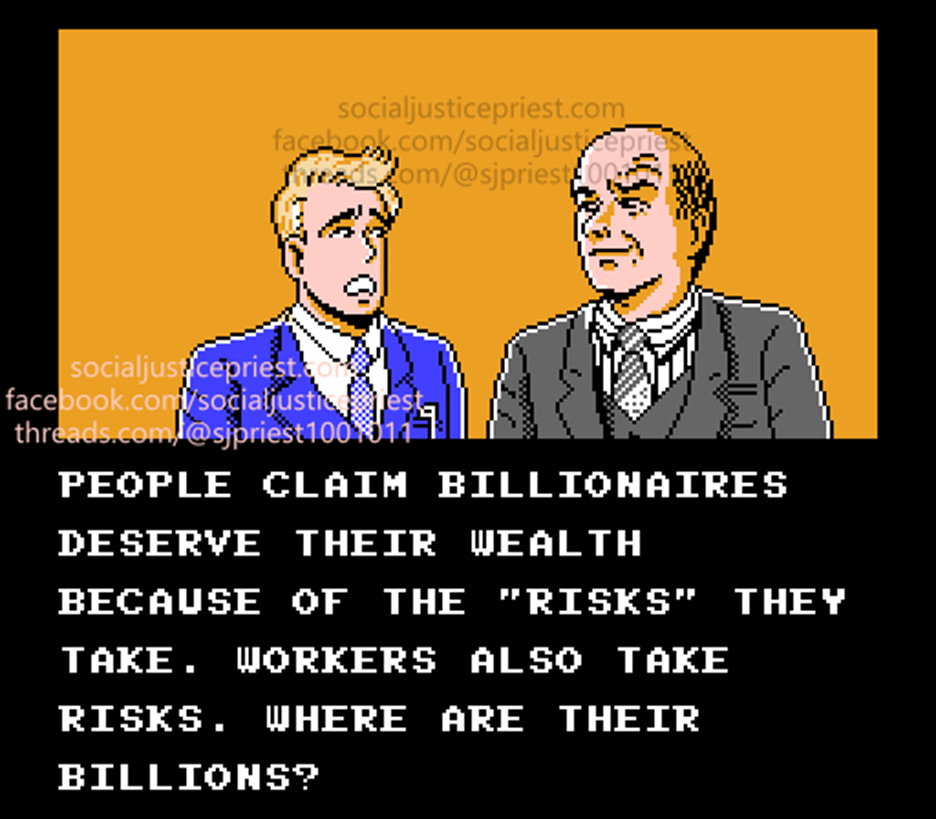
We’ve all heard it at least once. “Owners deserve to keep all the profits from their companies because they were the ones who took the risk of founding the business!” If you were like me when I heard it, you asked the person why that meant the owner deserved to keep all the profits. And you probably received a blank stare, a snide remark, or a nonsense explanation (“That’s just the way it is!”). But is it? Does the risk of starting a business mean the owner deserves to keep all the profits? No! Why? Because workers take risks, too!
Who is considered a worker? Anyone who sells their labor for a wage or salary as opposed to owning and controlling the means of production. A capitalist system only has two real classes: workers and owners. Laborers and managers are workers. While capitalism often pits them against each other, the system forces both to serve the owner class. While many managers take different risks than workers, they’re still risks.
What is risk? According to the dictionary, risk is “the possibility of loss or injury” (Merriam-Webster, 2026). This could mean technical risks, operational risks, external risks, management risks, commercial risks, occupational risks, or financial risks. Risks are always negative. Positive “risks” are considered “opportunities,” but they’re outside the scope of this article. Depending on the type of job the worker has, they could be taking some or all of these risks. For example, Amazon workers face occupational risks in the form of repetitive motion injuries, being forced to work in non-airconditioned warehouses without bathroom breaks, and being forced to work during tornadoes (Bruder, 2017; BBC, 2021; Kaplan et al., 2023; Wikipedia, 2026). Jeff Bezos, the owner of Amazon, has faced none of these risks. If risk is what entitles owners to all the profits, shouldn’t the workers, who risk their health and even their lives, be entitled to more of the profits than Bezos?
Some people will try to move the goalpost and claim risk only pertains to financial risks. This is a bad argument for three reasons:
1. Nearly all risks can be quantified monetarily, including the risks taken by workers. This is known as Expected Monetary Value (EMV), and I use it regularly during project management. EMV takes a list of risks and assigns monetary value to each of them by multiplying the probability of the risk occurring by the estimated financial impact.
For example, let’s look at heat-related illnesses for warehouse workers. The annual rate of heat-related illness severe enough to cause at least one missed day of work is 0.8 for every 10,000 workers (Monahan et al., 2026). If we assume these happen only during the hottest time of the year (around eighty days), that gives each worker a 0.0001% chance per shift of suffering a heat-related illness. The average cost of hospitalization for these illnesses is $15,000 (Woolf et al., 2023). Multiplying the two together, the EMV per worker per shift is $0.15. While that may seem inconsequential, it adds up. If a warehouse has 1000 employees per day, each serving one shift, the total is $12,000 of unpaid risk over the summer!
Again, that’s just heat-related illnesses. According to the U.S. Bureau of Labor Statistics (2026), each warehouse worker has a 4.1% yearly risk of suffering any kind of injury on the job.
2. Getting injured on the job can greatly reduce a worker’s earning potential. According to Blanton (2023), the “drop in earnings due to long-term injuries persisted for years, adding up to more than $50,000 over the 14-year follow-up period in the study.” Even if the worker fully recovered and didn’t have to take any days away from work, their annual earnings growth was “$1,152 (in 2000 dollars)” less than an uninjured worker (Dong et al., 2016). This adds another risk workers take.
3. Last but not least, workers take direct financial risks of wage theft. Wage theft is an “employer’s failure to pay workers money they are legally entitled to” (Meixell & Eisenbrey, 2014b). According to Meixell and Eisenbrey (2014a), the “total amount of money recovered for the victims of wage theft who retained private lawyers or complained to federal or state agencies was at least $933 million” in 2012. Again, that’s just recovered money. Who knows how much wage theft was unreported and unrecovered? For reference, property crimes like robbery totaled almost $341 million that same year (Meixell & Eisenbrey, 2014b). In more recent times (2021 – 2023), workers recovered $1.5 billion in stolen wages (Poydock & Zhang, 2024). Wage theft affects millions of workers. Even I experienced wage theft at a previous job (unfortunately).
For the reasons above, people claiming “workers don’t take financial risks” either haven’t done their research or are bluffing.
I’m not saying owners shouldn’t be entitled to any of the profits. (As a socialist, I believe the workers should decide how much profit the “owner” gets.) But if “risk” is the only justification, then the profits need to be spread around as much as the risk is!
Sources:
BBC. (2021, April 3). Amazon apologises for wrongly denying drivers need to urinate in bottles. BBC. https://www.bbc.com/news/world-us-canada-56628745
Blanton, K. (2023, November 7). Injured workers’ lost income adds up to thousands. Center for Retirement Research at Boston College. https://crr.bc.edu/injured-workers-lost-income-adds-up-to-thousands/
Bruder, J. (2017). Nomadland: Surviving America in the Twenty-First Century. W.W. Norton & Company, Inc.
Dong, X. S., Wang, X., Largay, J. A., & Sokas, R. (2016). Economic consequences of workplace injuries in the United States: Findings from the National Longitudinal Survey of Youth (NLSY79). American Journal of Industrial Medicine, 59(2), 106–118. https://doi.org/10.1002/ajim.22559
Dorman, P., & Boden, L. (2021, April 19). Risk without reward: The myth of wage compensation for Hazardous Work. Economic Policy Institute. https://www.epi.org/unequalpower/publications/risk-without-reward-the-myth-of-wage-compensation-for-hazardous-work/
Kaplan, A., McCorvey, J. J., & Wazir, Z. (2023, August 6). Warehouses are booming as summers heat up and workplace safety rules lag. NBC News. https://www.nbcnews.com/investigations/warehouse-workers-extreme-heat-illness-osha-rcna95936
Meixell, B., & Eisenbrey, R. (2014a, September 11). An epidemic of wage theft is costing workers hundreds of millions of dollars a year. Economic Policy Institute. https://www.epi.org/publication/epidemic-wage-theft-costing-workers-hundreds/
Meixell, B., & Eisenbrey, R. (2014b, September 18). Wage theft is a much bigger problem than other forms of theft—but workers remain mostly unprotected. Economic Policy Institute. https://www.epi.org/publication/wage-theft-bigger-problem-forms-theft-workers/
Merriam-Webster. (2026, July 19). Risk definition & meaning - merriam-webster. Merriam-Webster. https://www.merriam-webster.com/dictionary/risk
Monahan, K., Ranger, A., & Constible, J. (2026, July). Rising temperatures, rising risks: An investor guide to heat hazards and worker safety. NRDC. https://www.nrdc.org/sites/default/files/2026-07/Occupational_Heat_Guide_R_26-06-E_03_locked.pdf
Poydock, M., & Zhang, J. S. (2024, December 20). More than $1.5 billion in stolen wages recovered for workers between 2021 and 2023. Economic Policy Institute. https://www.epi.org/publication/wage-theft-2021-23/
Talent.com. (2026). Warehouse worker salary in United States of America — average salary. Talent.com. https://www.talent.com/salary?job=warehouse+worker
United States Department of Labor. (2026, January 22). Table 1. incidence rates of nonfatal occupational injuries and illnesses by industry and case types, 2024. U.S. Bureau of Labor Statistics. https://www.bls.gov/web/osh/table-1-industry-rates-national.htm
Wikipedia. (2026, July 2). Edwardsville Amazon warehouse collapse. Wikipedia. https://en.wikipedia.org/wiki/Edwardsville_Amazon_warehouse_collapse
Woolf, S., Morina, J., & French, E. (2023, June 27). The health care costs of extreme heat. Center for American Progress. https://www.americanprogress.org/article/the-health-care-costs-of-extreme-heat/
Enjoying my content?