

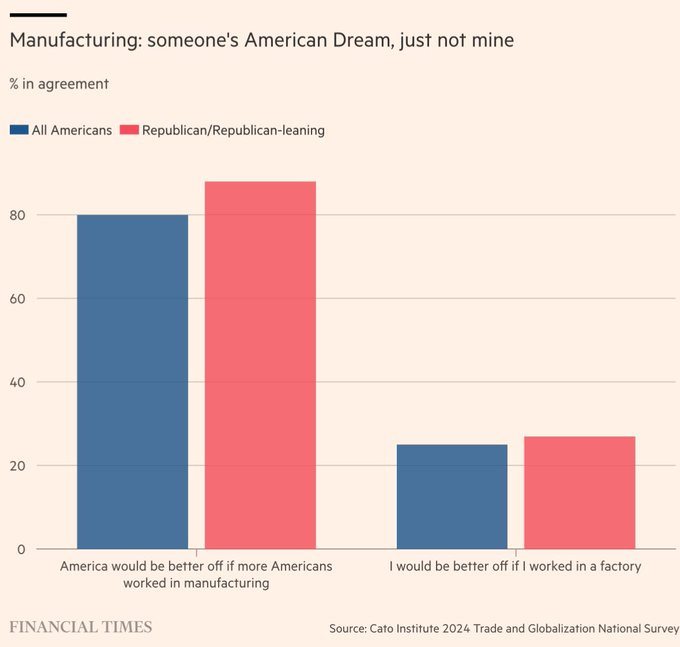
Most Americans believe “reviving the manufacturing industry” will solve our economic problems. And indeed, the Gini Coefficient in US was lower when the number of manufacturing jobs was higher [1]. However, correlation doesn’t equal causation. Life wasn’t better for working Americans between 1950 and 1980 because of the manufacturing jobs, life was better because wages were higher, the pay gap between the owning and working classes was smaller, housing was cheaper, and higher education wasn’t required to earn a living wage. Bringing back these benefits will improve life for the working class, and we don’t need manufacturing jobs for that!
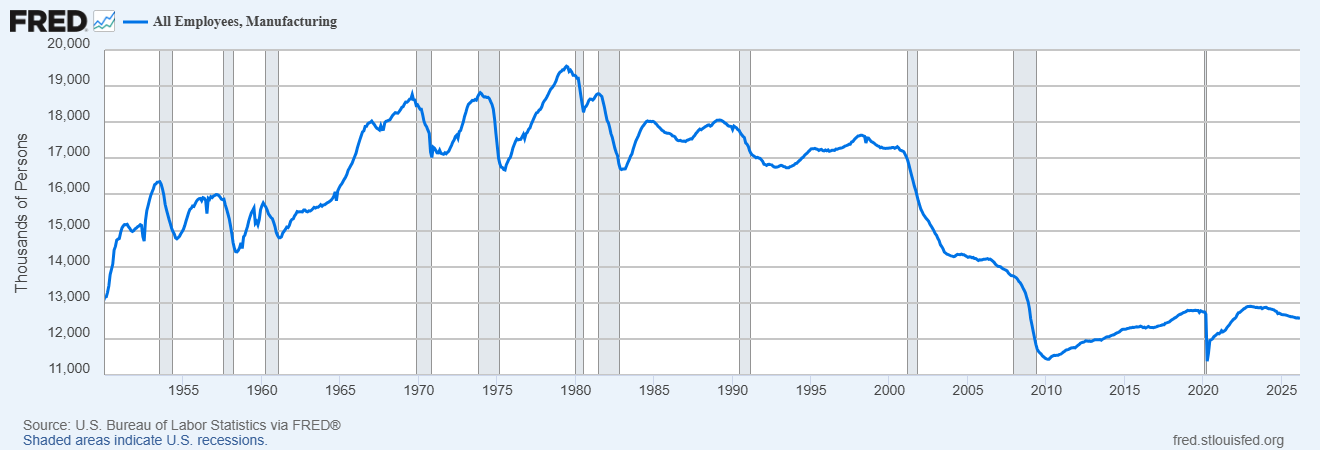
What do people mean when they talk about “reviving the manufacturing industry?” What most of them mean is they want to return to a time when a man (usually) with a high school diploma could work a job that afforded him a house and supported a family of four on a single income. This was the time between 1950 and 1980, when the number of manufacturing jobs increased before peaking in 1979 (see Figure 1) [2]. But like most forms of nostalgia, this vision of America’s manufacturing industry is inaccurate.
So what was really happening?
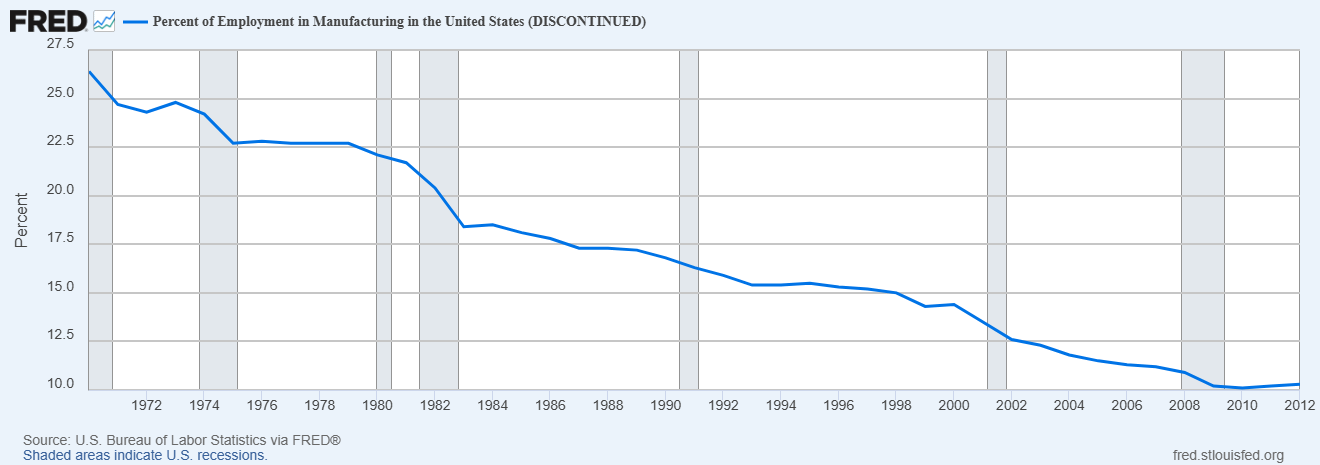
Manufacturing jobs were already becoming a smaller part of the economy. While the number of manufacturing jobs increased between 1950 and 1980, the percentage of people employed by the manufacturing industry steadily fell during that time. According to the Urban Institute, about a third of America’s workforce had a job in manufacturing in 1960 [3]. By 1980, that number fell to less than 25% [3]. While the Federal Reserve Bank of St. Louis couldn’t provide the full spectrum, the period from 1970 to 2012 showed a similar decline (see Figure 2) [4]. Manufacturing lost almost 10% of its jobs to other industries while most people believed it was at its peak. As of 2015 and 2026, both the percentage and number, respectively, of people employed by manufacturing have continued to decline [2][3].
In my opinion, there are three reasons these jobs are never coming back:
1. Technological advancements. Improvements in manufacturing technology have allowed companies to produce more with fewer people through automation. This caused productivity to rise in the manufacturing industry and the number of workers needed to decline [5].
2. Other industries have taken their place. While technology has caused a decline in the need for manufacturing labor, it has increased the need for other forms of employment. Indeed, technological advances have caused job growth in fields that barely existed in the 1970s (e.g. information technology) [6]. Most Americans now work various service jobs [3][7]. This brings me to the next issue: available labor.
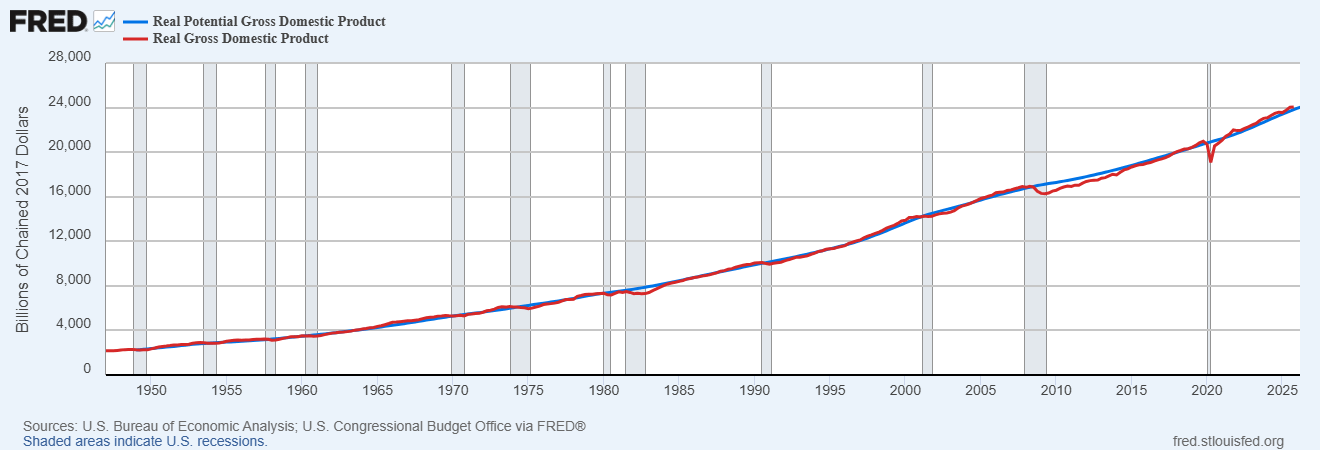
3. There simply aren’t enough people to fill these positions. Before I get into this, I need to explain how unemployment is measured. There are three types of unemployment: frictional, structural, and cyclical [8]. Frictional unemployment is temporary unemployment caused by people quitting their jobs to move to new locations or quitting their jobs to look for other positions. Structural unemployment is unemployment caused by there being more people who want to do jobs than there are available jobs (e.g. there are only ten positions to be a lead actor in a movie and 100 people who want that role). This type of employment is usually long-term and leads to people either eventually finding jobs in another industry (after reskilling) or leaving the labor force entirely. Lastly, there is cyclical unemployment. This is the type of unemployment that happens during economic recessions. For example, the mass loss of jobs in 2008 and 2020 were types of cyclical unemployment. The total amount of frictional and structural unemployment in a country is considered its natural unemployment rate. Cyclical unemployment causes a country’s unemployment to move above or below its natural rate. A country is at full employment when there is zero cyclical unemployment. That’s right, “full employment” does not mean “0% unemployment.” Achieving that would be impossible.
Full employment is determined by comparing the Real Potential Gross Domestic Product (GDP) with the Real GDP (see Figure 3). When the lines intersect, a country is all full employment. The US has been at or above (because that’s a thing, too) full employment since the end of 2021 [9]. Though growth is slowing down because of Trump, we’re still above full employment. (This is known as an inflationary gap. It’s outside the scope of this article, but I recommend you look it up!) Even if we still had a demand for manufacturing jobs, there would be no one to fill them.
If manufacturing jobs are gone for good, how do we recapture the standard of living associated with their peak? As I stated before, it wasn’t the manufacturing jobs themselves that created that standard of living, it was the benefits. For example, the minimum wage (in 2023 dollars) in 1979 was higher than it is now: around $12/hour vs. $7.25/hour [10]. Additionally, wages increased steadily with productivity, something that started changing in the 1970s. This was in line with a shift in corporate attitude towards employees. Instead of being viewed as assets, corporations started to view them as liabilities. This sentiment was only exacerbated by Ronald Reagan and the implementation of Neoliberalism in the 1980s. Reclaiming our previous standard of living will require reversing many of the changes that started in the 1970s and 80s while implementing new policies.
Raising the minimum wage:
People aren’t making enough money, period. The medium household income in the US is about $84K/year [11]. Meanwhile the amount of money a family of four needs to live comfortably in the US is anywhere between $178K and $301K [12]. As stated above, the current minimum wage is lower (adjusted for inflation) than it was in 1979. If wages had kept up with productivity, the minimum wage would be $26/hr [13]. While it would be a shock to the economy to raise it this high overnight, multiple states, like Hawaii, have successfully raised the minimum wage to as high $18/hr by doing it over the course of a few years [14]. There’s no reason we couldn’t do this at the national level.
Critics of minimum wage increases argue it will increase prices and decrease unemployment, but neither of these concerns are valid. While minimum wage does slightly increase prices, it is far below that of the wage increase itself. For example, one study found that a 10% rise in the minimum wage led to only a 0.4% increase in prices [15]. Raising the minimum wage has shown no significant jobs losses and some studies have even shown an increase in employment [16][17][18]!
Alternatively, we could pass a universal basic income high enough to eliminate poverty. Companies currently relying on desperation to find employees would have to raise wages and/or improve working conditions instead.
Increasing union membership:
Unions work (no pun intended)! Studies have shown not only do unions improve working conditions and pay for both union and non-union workers, they increase productivity [19][20][21][22]. Additionally, the decline in union membership aligns with the rise in wealth inequality between the top 1% of earners and the remaining 99% [19]. While the large tax cuts for the rich in the 1980s also contributed to the growth in wealth of the 1%, the decline in unions hindered workers’ abilities to fight for higher wages. The result was wage stagnation [23].
Unions serve the secondary function of creating a dual power system. Instead of it being the owner class against individual workers, unions provide workers with a means for collective action against owners who wish to exploit them. In addition to the larger salaries unions usually win for workers, unions provide other ways to check corporate power. For example, if unions find out the owner of the factory uses the profits to support fascism, they can go on strike until the owner changes their donation habits.
Raise taxes on the rich:
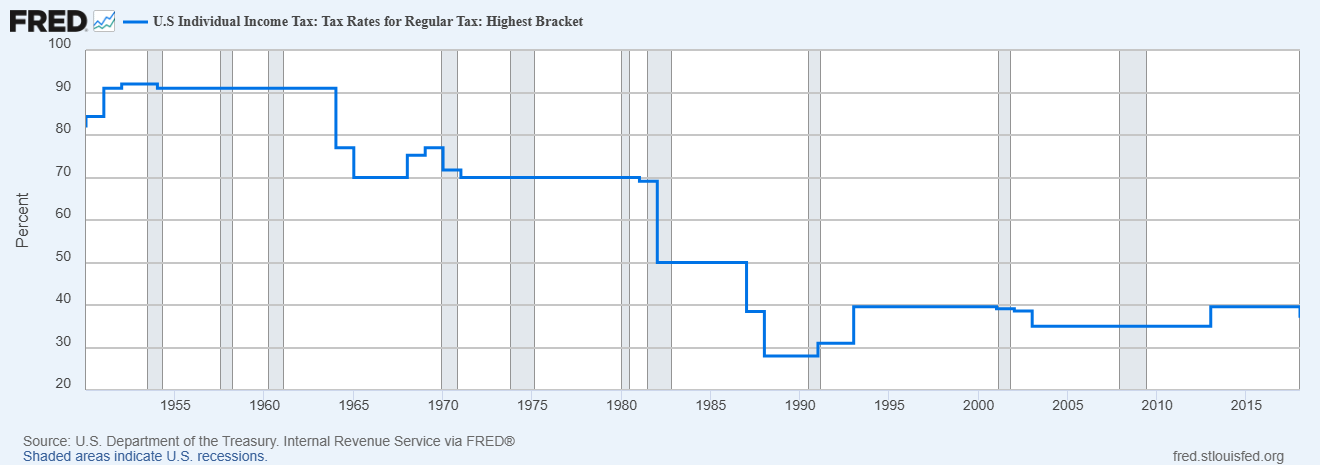
What many of the people who are nostalgic about the 1950s and 1960s don’t tell you is the income tax rates at the time were much higher than they are now (see Figure 4)[24]. Higher taxes incentivize owners to reinvest revenue back into their companies instead of keeping it for themselves as income. Companies are only taxed on profits. Profits = Revenue – Expenses. Owners who want to avoid corporate taxes can spend the money on the business (an expense) instead of paying it as taxes. This means better equipment, higher wages, more money spent on training, and better benefits for the workers. If income taxes are lower, the owner is incentivized to give himself a large end-of-year bonus instead of reinvesting that money. Frankly, I would be okay with raising taxes on the rich even if it provided zero direct benefits. The wealthy having less money in their pockets means they have less money to buy politicians!
Untethering healthcare from employment:
Having healthcare tied to employment both lowers worker mobility and decreases the power of unions [25]. Both have the secondary effect of suppressing wages. If workers know leaving a job means they lose their health insurance, they are less likely to do so even if they believe they’re underpaid or their work environment is unsafe. Company-provided health insurance gives employers a bargaining chip to use against unions who wish to negotiate better benefits, higher pay, and/or safer working conditions. In my opinion, the best way to separate healthcare and employment is to implement universal healthcare. That would also have the added benefit of getting rid of health insurance.
Address the housing crisis:
The housing problem in America has two main parts: a myriad of empty homes that are either not for sale or are unaffordable and a lack of affordable housing. The former can be combatted with vacancy taxes. Vacancy taxes are taxes levied on unoccupied residences. This incentivizes people who buy homes and just sit on them as investments to either sell them or make them available for renting. A study in France showed a vacancy tax decreased vacancy rates by 13% [26].
The latter can be combatted by building more high-density housing. Critics claim high density housing always decreases property values. This only happens when it’s isolated from other places and/or clustered together. When it’s integrated with other forms of housing, there’s no evidence of it reducing the value of the surrounding properties [27].
In my opinion, the government should give every adult at least a one-bedroom apartment. There are multiple benefits to this, but that is a discussion for another article.
Providing more and better opportunities for people without college degrees:
I loved attending college. Getting my bachelor’s and master’s degrees both improved my career prospects and helped me change and grow as a person. But that doesn’t mean it’s for everyone. Some people don’t want to go to college, but well-paid jobs often require a college degree. Many people are advocating for going to trade schools instead, but trade schools are still schools. One of the advantages of manufacturing jobs is they often required only a high school diploma—and sometimes not even that. Someone could get a job at eighteen and earn enough to support a family. Even though there are still jobs that don’t require a degree, they often pay very little (e.g. fast food jobs and childcare). Addressing the low minimum wage and the lack of unions should solve this problem.
Making college degrees more affordable:
What about the people who do want to go to college? Maybe they want to be doctors, lawyers, engineers, social workers, or scientists? Why does it cost tens of thousands of dollars to do this? Well, it didn’t always. One of the great ironies in the current discourse about higher education is many of the people who want everyone to attend trade school instead of college “to save money” got their degrees for next to nothing. It was California Governor Ronald Reagan who started cutting state funding for higher education, forcing colleges to charge higher tuition fees [28]. He did this to combat the threat of the “educated proletariat.” In other words, he didn’t want the working class to become too smart. Nixon followed suit at the national level, and Reagan continued it when he became President. There’s no reason we can’t bring back federal funding for colleges, allowing them to lower—or better yet eliminate—tuition. Speaking of tuition, we should cancel student loan debt. If people who paid off their loans want to complain, we can give them a check for what they paid off.
Last but not least, as a Black person I would be remiss if I didn’t address the elephant in the room: white people reaped most of these benefits. Black people had very little control of the political process. In the 1960s most of them couldn’t even vote, especially in the South. Even among the Black people who could vote, very few politicians catered to their interests. Additionally, many of the housing developments that benefited white people in the 1950s and 1960s excluded Black people. In fact, the suburbs were designed specifically to keep Black people out. But I said “most,” not “all.” Black people did benefit from the prevalence of manufacturing jobs. These jobs were often one of the few paths toward the middle class available for Black people at the time. The disappearance of these jobs disproportionately affected Black employment levels. That said, the main issue wasn’t the loss of the manufacturing industry specifically, it was the failure of the “free market” to create new opportunities for displaced Black workers. Opportunities that were given to many displaced white workers. The solution to this problem is for the government to step in and provide jobs and/or job training near areas with high unemployment. Oh wait, that’s “socialism.” My bad!
Sources:
[1] https://data.worldbank.org/indicator/SI.POV.GINI?end=2023&locations=US&start=1963&view=chart
[2] https://fred.stlouisfed.org/series/MANEMP#
[3] https://www.urban.org/sites/default/files/publication/97776/manufacturing_employment_fact_and_fiction_2.pdf
[4] https://fred.stlouisfed.org/series/USAPEFANA
[5] https://fred.stlouisfed.org/graph/?g=1NZ1h#
[6] https://www.prnewswire.com/news-releases/number-of-it-workers-has-increased-tenfold-since-1970-census-bureau-reports-300314342.html
[7] https://www.bls.gov/emp/tables/employment-by-major-industry-sector.htm
[8] Principles of Economics by N. Gregory Mankiw
[9] https://fred.stlouisfed.org/series/GDPPOT#
[10] https://www.epi.org/blog/a-history-of-the-federal-minimum-wage-85-years-later-the-minimum-wage-is-far-from-equitable/
[11] https://fred.stlouisfed.org/series/MEHOINUSA672N
[12] https://www.visualcapitalist.com/mapped-the-income-a-family-needs-to-live-comfortably-in-every-u-s-state/
[13] https://www.cbsnews.com/news/minimum-wage-26-dollars-economy-productivity/
[14] https://www.ncsl.org/labor-and-employment/state-minimum-wages
[15] https://gspp.berkeley.edu/research-and-impact/publications/the-pass-through-of-minimum-wages-into-us-retail-prices-evidence-from-supermarket-scanner-data
[16] https://www.epi.org/blog/most-minimum-wage-studies-have-found-little-or-no-job-loss/
[17] https://www.nelp.org/insights-research/raise-wages-kill-jobs-no-correlation-minimum-wage-increases-employment-levels/
[18] https://sp2.upenn.edu/study-increasing-minimum-wage-has-positive-effects-on-employment-in-fast-food-sector-and-other-highly-concentrated-labor-markets/
[19] https://home.treasury.gov/news/featured-stories/labor-unions-and-the-us-economy
[20] https://pmc.ncbi.nlm.nih.gov/articles/PMC4880255/
[21] https://www.illinoisepi.org/2015/06/02/unions-increase-productivity-in-the-construction-industry/
[22] https://www.epi.org/press/new-report-details-the-benefits-of-unions-to-workers-communities-and-democracy/
[23] https://www.epi.org/publication/charting-wage-stagnation/
[24] https://fred.stlouisfed.org/series/IITTRHB
[25] https://www.mdpi.com/1911-8074/15/7/296#:~:text=Our%20study%20uses%202001%E2%80%932019,full%20implementation%20of%20the%20ACA.
[26] https://doi.org/10.1016/j.jpubeco.2019.104079
[27] Poverty, by America by Matthew Desmond
[28] https://www.bestcolleges.com/news/analysis/threat-of-educated-proletariat-created-the-student-debt-crisis/
Enjoying my content?
These are terrific policy proposals which I agree with wholeheartedly, but I'm wondering about scale issues such as once a nation state gains dominance in a particular industry then it may be necessary to abandon competition and just come up with totally new industries, which of course requires geopolitical savvy and technical creativity.
It seems to me that China is slowly but surely creeping toward a global domination where the human agency of their massive population will give advantages that Americans will never see again now that they've been squandered by American conservatives.
Bill Gates got some attention a few years back when he mentioned having a tax on robots that would apply towards UBI and I really like the vacancy tax idea, which I hadn't heard of until I read this article, so many thanks for that :)
And of course, we have to get off the petro tit, which China also seems to be addressing even as we Yanks idiotically careen towards repeating catastrophe.
We've got to do whatever it takes to get our best brains back to college no matter what their upbringing, but that won't happen until we do whatever it takes to slay the conservative Ultra class dragon once and forever.
Well done, and keep on keeping on!