

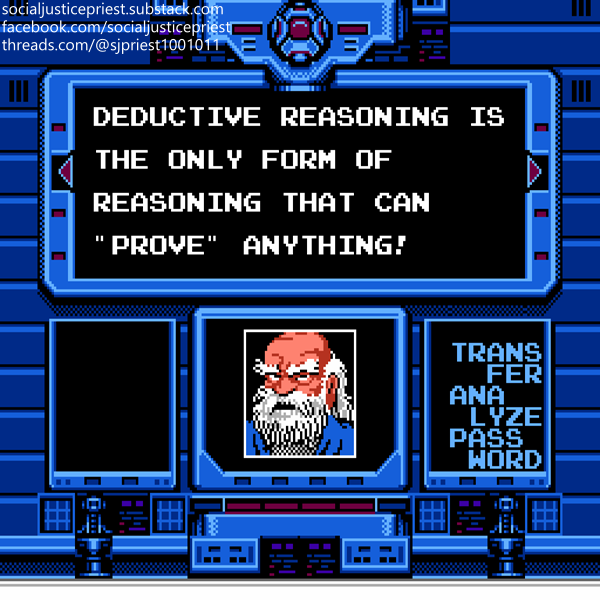
There are five types of logic: deductive reasoning, inductive reasoning, abductive reasoning, analogical reasoning, and decompositional reasoning. This article will focus only on deductive reasoning.
Deductive reasoning is the act of drawing a conclusion about a specific object, person, idea, or group from one generalization or a set of generalizations. The most basic form of deductive reasons is “principle implies consequence. Mathematically this is commonly written as:
p → q
p
Therefore, q.
The principle (or premise), p, always leads to consequence (or conclusion), q [1]. For example: When Tom fills a glass, he always fills it to the top. Tom filled a glass. Therefore, that glass is filled to the top. In this case, Tom filling a glass is the principle (p). The glass being filled to the top is the consequence (q). The consequence was deduced from the principle.
Another way to write this argument is using the contrapositive. The contrapositive takes the opposite of the principle and consequence and flips them:
NOT q → NOT p
NOT q
Therefore, NOT p.
The contrapositive is logically equivalent to the original statement. In other words, if the original statement is true, so is its contrapositive. The contrapositive is useful in cases when proving or disproving the original statement would be impractical, but doing the same to the contrapositive would be easy.
Another version of deductive reasoning is the syllogism. A syllogism is two principles followed by a consequence. In the same as above, if the principles are true, the consequence is also true. The most common example of a syllogism is:
All humans are mortal.
Socrates is a human.
Therefore, Socrates is mortal.
If it is true all humans are mortal and true Socrates is a human, then he must be mortal by virtue of being a human. One could also say Socrates, being a human, was part of a set called “HUMAN.” This brings me to the next topic.
Sets are essential to Set Theory (as if the name didn’t give that away). A set is a collection of one or more discrete objects. Once someone creates a set, every object in the universe can be defined in terms of that set. To use the example above Socrates is an object in the set known as “HUMAN.” This means Socrates shares all the properties attributed to set HUMAN. In the above example, HUMAN only has one property: mortality. Because Socrates is part of the set, he shares this property. But let’s say there is an object outside of HUMAN. Let’s call this object Gabriel. Because Gabriel is not part of the set HUMAN, the properties of the set aren’t attributable to them. They could be mortal like Socrates, they could not be. We don’t know. Mathematically, I would define the Gabriel in terms of the existing set as “NOT HUMAN.” Sounds a bit silly, right? In reality, Set Theory is extremely useful. Binary, the language of computers, is based on Set theory. No Set Theory, no computers or smartphones!
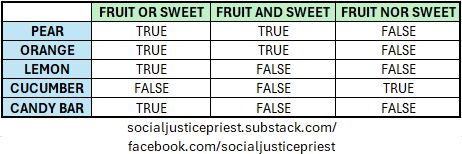
Set Theory doesn’t just cover a single set. It can also be used to describe how multiple sets interact with each other. For this example, I will create two sets called “FRUIT” and “SWEET.” FRUIT contains all objects classified as fruits. SWEET contains all objects classified as sweet. I could technically name these sets anything. (I could call one “BOB” and the other “DAN” if I wanted.) It would still be a set of all fruits and all sweet foods because that’s how I defined them. The properties are what’s important, not the names. I also have five objects: a pear, an orange, a lemon, a cucumber, and candy bar. I can define the objects in terms of both sets using OR, AND, and NOR (NOT OR). The pear, the orange, the lemon, and the candy bar are part of either FRUIT OR SWEET. Only the objects pear and orange are part of FRUIT AND SWEET. The cucumber stands alone as being part of neither FRUIT NOR SWEET. (See table below.) This is the true power of Set Theory. NOR gates are essential for designing circuits. Most modern processors are built from millions of NOR gates, in fact.
Lastly, I want to discuss the transitive property, which combines all of what I explained above. The transitive property is a syllogism of principles or sets. The transitive property goes as follows:
A → B
B → C
Therefore, A → C.
A great example of this would be, ironically, Ayn Rand’s Objectivism. According to Objectivism, the government should exist only to protect individual rights. Rand states no right is more sacred than the right to one’s own life [2]. This means a government that exists to protect individual rights would have to guarantee all our basic needs. Why? The transitive property!
The government (A) exists to protect people’s rights to their own lives (B).
To live (B) humans need food (C).
Therefore, the government (A) must provide food (C).
This extends to all other basic needs such as water, clothing, shelter, medicine, and possibly electricity. While that wasn’t the original intention of Objectivism, intent doesn’t matter with deductive reasoning.
The advantage of deductive reasoning is it’s the only form of reasoning capable of proving something true or false. In the case of the first example I used, it proved a glass filled by Tom will always be filled to the top. The disadvantage is it requires its premises already be true. If this isn’t the case, deductive reasoning can lead to logical fallacies and/or incorrect conclusions. Syllogisms are vulnerable to the affirmation of the consequent fallacies and hasty generalizations, to name two examples. Misapplying Set Theory can lead to false dichotomies along with multiple other fallacies. The transitive property can be used to link things that aren’t really connected. Some might argue my use of the transitive property above fits in that category, but those people are wrong. To be fair, however, it does highlight another issue with deductive reasoning: sometimes it has unintended consequences (no pun intended)! I’m sure Rand didn’t intend for Objectivism to be used to support a robust welfare state, but that’s where the logic led!
Source:
[1] Discrete Mathematics with Applications, Third Edition by Susanna S. Epp
[2] https://aynrandlexicon.com/lexicon/individual_rights.html
Enjoying my content?