

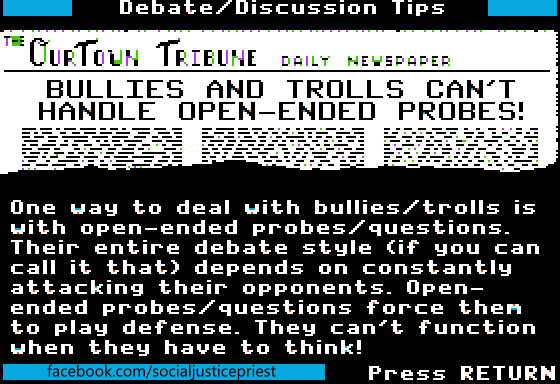
One way to deal with bullies/trolls is with open-ended probes/questions. Their entire debate style—using the term “debate style” loosely—depends on them constantly playing offense. Open-ended probes/questions force them to play defense, disengage, or evade points—more on that last one later.
Before I go any further, I want to say you have zero obligation to engage bullies/trolls. There is no shame in ignoring them, telling them to take a hike (or something less polite), and/or blocking them. Do what you need to do to protect your peace/mental health. That will always be more important than any Internet squabbles. If you’re interested in messing with them, however, keep reading!
The main goal of bullies/trolls is to silence you. That’s why they pick fights with people. They want to make your online experience so painful that you never voice your opinions, which disagree with theirs, again. In some cases, they don’t actually disagree with you. They just don’t want people who like you (women, Black, gay, liberal, leftist, etc.) voicing their opinions online. Allowing people like to you feel comfortable online sets a “dangerous” precedent. What if you do eventually say something they don’t like? Or what if someone else thinks it’s safe for them to do the same because you didn’t get bullied off the Internet for having similar views?
Responding to trolls with open-ended probes/questions serves two main purposes. First, it makes you a more difficult target. As stated in the meme, bullies/trolls are at their best when they can constantly attack. Open-ended probes/questions break their rhythm because they’re hard to respond to than close-ended questions/statements. Bullies/trolls are opportunists. If you become harder to harass, they will be disinclined to engage you in the future. Second, it poisons the water. If bullies/trolls know there are people willing to fight back in a way they can’t handle, they will be hesitant to pick on others. What if the next person they choose responds to them in the same way you did?
Bonus: there’s a chance this will make bullies/trolls more open to your point of view. Open-ended probes/questions are a reliable, but not perfect, way to raise someone’s receptivity to your ideas. Open-ended dialogue encourages reciprocity. In Street Epistemology (the real kind, not most of the stuff found on YouTube) asking people questions about themselves and what they believe makes them like you more—even when they’re trying their best to hate you. The result is they begin to feel obligated to give your points of view at least a little consideration. The goal of Street Epistemology is not to convert people to your point of view, but to plant a seed. That said, I don’t recommend trying this solely to plant a seed in a bully’s/troll’s head. In my opinion, that time/energy is better spent elsewhere. You will bring more people to your cause establishing your spaces as safe for marginalized people. Being nice should always take a back seat to being good [1].
I personally prefer probes to questions. One that often works for me is, “Please provide a source for your claim” or “[citation needed],” if I don’t feel like being polite. This forces them to prove their claim. The only two ways they can respond are by providing sources (which they probably won’t have) or by claiming they don’t need proof. If they do the latter, you can respond with, “Claims without evidence can be dismissed without evidence.” It’s true. The burden of proof is always on the person making the claim. For example, if they want to claim illegal immigrants are the ones smuggling fentanyl into America (this is false), it’s their job to prove it. If they can’t, that’s not your problem!
If you’re into questions, “Why do you believe that?” is useful [2]. Bullies/trolls will usually come back with “because it’s true!” In that case, you can follow it up with “How do you know it’s true?” or “Could you please provide me with some evidence?” If they try to accuse you of sealioning, you can respond with, “How am I sealioning when you were the one who engaged me?” Another one I like to use if they get frustrated with questions is, “Why are you starting arguments with people if you don’t want to back up what you say?”
What if they evade your probes/questions either by ignoring them or changing the subject? Call them out! If they refuse to answer your question, ask it again and remind them this is the second time you’ve asked. Ask them why they refuse to answer your questions. If they keep evading, you can either mock them for being unable to answer your questions and/or use it as a reason to disengage. “Since you’re unwilling to answer my questions, I’m just going to assume you can’t. I’m not interested in a discussion with someone who doesn’t know what they’re talking about!” If you don’t feel like being polite, you can say, “Since you can’t stay on topic, I’m going to assume you have nothing more to add. I accept your surrender!” Make it your own! However you choose to end the conversation, it will be the bully/troll who’s embarrassed/exhausted and not you!
Sources:
[1] https://www.psychologytoday.com/us/blog/social-instincts/202412/being-good-is-better-than-being-nice-in-a-relationship
[2] Leadership Through People Skills by Robert E. Lefton, Ph.D., and Victor R. Buzzotta, Ph.D.
The rest comes from my own knowledge acquired through higher education, my own experiences dealing with bullies/trolls, and my over twenty years in the workforce, including serving in leadership roles.