

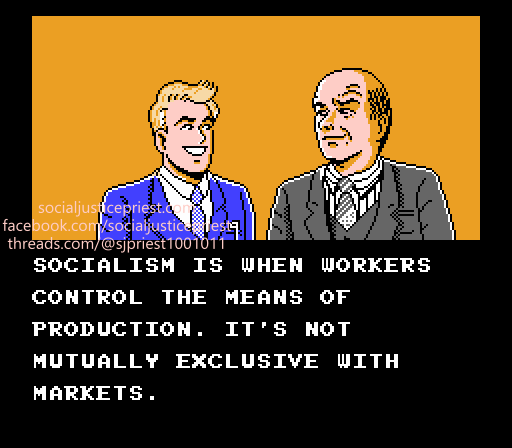
With income inequality continuing to grow and the election of Mayor Mamdani in NYC, we’re hearing more people talk about capitalism, socialism, and communism [1][2]. Unfortunately for us, however, few people talking about these economic systems seem to understand what they are. To provide some clear definitions, I will be writing an article about each one. The articles will describe what they are, what they’re not, and how I feel about them. This article will be about socialism. (Read the articles on capitalism and communism.)
What is Socialism?
Socialism is an economic system where the means of production (factories, farms, data centers, software, etc.) are controlled democratically by the workers. This can be done through direct democracy (one person one vote), democratically electing a term-limited CEO and/or board of directors to run the company, democratically controlling the companies at the industry level (e.g. all software companies get together to form a democratically-elected governing body for their industry), or allowing the means of production to be controlled by a publicly-accountable state. What’s most important is the workers decide what’s done with the company’s profits. They can choose to split them equally among themselves or choose to save them all for a rainy day, to name a couple of examples. This is different from capitalism where the means of production are privately controlled by the owner(s) of the company, and the owner(s) gets to decide what to do with the profits.
To provide an example of how a company would function under socialism, let’s take a fictional software company that sells operating systems: Macrohard.
Under capitalism, Macrohard’s software (its means of production) is privately controlled by the owner of the company, Will Doors. Doors decides what to do with that software. He decides to use it to sell goods and services—and how much of each—related to his operating system. Doors hires workers to use Macrohard’s software to do this. Macrohard generates revenue by selling the operating systems (goods) and the maintenance of them (services). He pays his workers a wage. Assuming there are no other expenses, Macrohard’s profits are the difference between the revenue and the workers’ wages. Doors, and Doors alone, gets to decide what to do with that money.
Under socialism, the workers control the software. They democratically decide what they want to do with it. Some of the workers got trained in Lean Six Sigma and figured out spending more time developing better software would reduce the number of hours spent on maintenance. They share this knowledge with the rest of the workers. Workers vote to focus more on developing quality goods and providing fewer services. Their decision paid off and now Macrohard is much more profitable. The workers vote on what to do with the money. Doors wouldn’t be excluded from this process. He is still a worker and therefore also gets a vote. In fact, his workers may vote to make him CEO of the company. They may also choose to give him a large salary, which could include a fixed percentage of the profits. Or they may not. That’s democracy: those who are doing the work decide what’s best for the company.
What isn’t Socialism?
Russia, Cuba, Vietnam, North Korea, China, etc. None of these countries are socialist because workers don’t control the means of production. Russia doesn’t even claim to be socialist anymore. Russia has operated under “free market” capitalism since 1991. Cuba is state capitalism. China is a mix of state and market capitalism. While all three of these countries either aspired to, or are aspiring to, communism (which would require socialism), they aren’t there yet. This brings me to another country some people keep claiming is “socialist.”
Venezuela. One reason some people label Venezuela as socialist is to justify the West’s imperialist stance towards it. We can sanction and attack them because they’re “socialist” and therefore “bad.” In reality, 70% of Venezuela’s economy is privately controlled [3]. (I used Fox as a source so people can’t claim this assessment is “liberal propaganda.”) That makes them no more “socialist” than Norway, which is a type of…
Social Democracy. Social Democracy is a form of capitalism where the government uses the taxes it collects from companies and the wealthy to provide social services and a robust social safety net while reining in corporate power. Some of these social services include healthcare, public transportation, tuition-free college, paid parental leave, and universal childcare. The Scandinavian countries, which are often held up as examples of socialism, are actually social democracies. “Socialist” politicians in the US like Bernie Sanders and Alexandria Ocasio-Cortez are actually social democrats. While social democracy would be a step in the right direction for the US, it’s still capitalism.
“The government doing stuff.” Socialism requires only one thing from the government: enforcing worker control of the means of production. It doesn’t require any of the public services often associated with socialism, like universal healthcare. There is nothing stopping a government in a socialist country from providing public services, however. In fact, it’s more likely the government will implement popular policies like universal healthcare because it’s more beholden to the people (more on this later) [4][5].
Centrally planned economies. While they’re allowed under socialism, they aren’t a requirement. Socialism can also have markets. Regardless of what method is used to determine production, socialism requires the workers to be the ones who decide.
Autocracy/state control of the economy. Socialism is incompatible with autocracy. Socialism must be democratic, which is why the phrase “democratic socialism” is redundant. If the state can seize ownership of the means of production or force worker-controlled companies to vote a certain way, then it’s not socialism. It’s state capitalism with extra steps. This is not to say there can’t be circumstances where the state needs to direct production, but this must be temporary. If it’s permanent, it’s no longer socialism because workers no longer control the means of production. And speaking of autocratic states…
Nazis. The Nazis were both anti-communist and anti-socialist. They completely dismantled workers’ rights, put communists, socialists, trade-unionists, and others in concentration camps, and privatized nearly every public-controlled industry [6]. In fact, the word “privatize” comes from Nazi Germany [7]. “But SJP, they were called ‘National Socialists!’” So? Anyone can call themselves anything. North Korea calls itself democratic. That doesn’t mean it is. In fact, Hitler himself stated he only called the party socialist to make it more attractive to the masses. He “paid lip service to the tenets suggested by a name like National Socialist German Workers’ Party, but his primary—indeed, sole—focus was on achieving power whatever the cost and advancing his racist, anti-Semitic agenda” [8]. The wealthy German oligarchs who backed Hitler knew what he was really about (yep, the ultra-rich backing fascists is not a recent phenomenon) [9]. If that’s still not enough evidence, Hitler killed the remaining socialists in the party during the Night of Long Knives [10]. The Nazis weren’t socialists.
Everyone being poor. Poor is defined as “lacking sufficient money or material possessions” [11]. There’s no proof socialism makes everyone poor. This idea comes from people equating socialism with a misunderstanding of communism. People mistakenly believe communism means everyone will be poor because that’s what the public education system here in the US taught us. For example, most of our schools taught us Cuba was poor because it was “communist” and not because of the military-enforced embargo we’ve had against the country for decades. Communism is a moneyless, classless, and stateless society [12]. People can’t be poor under communism because there is no money to lack and everyone’s basic needs (and then some) will be met.
How do I feel about it?
As you can probably tell from this article, I’m socialist. Capitalism was a step above the systems it replaced (feudalism and mercantilism), but we no longer live in the society capitalism was designed to accommodate. Capitalism developed alongside the steam engine. Now, we have the transistor. Like MLK Jr., I believe it’s “outlived its usefulness” and needs to be replaced with something else [13].
Why socialism? Because the owner class has too much power. Capitalism is a system where money is power. It allowed a few people to acquire more money than they could spend in several lifetimes while most of the country (and even the world) has very little. This wealth disparity gives owners the power to buy politicians and force “democracies” like the US to bend to their will. It also allows them to run experiments on entire populations without any input from either experts in the field or any ethical considerations [14][15]. Socialism is the most effective way to combat this.
Most of the wealth the owner class accrues comes from their ability to keep most or all the profits made by the companies they own. This means if the company makes $1B in profit, the owner gets all of it and can use that money however they wish. Under socialism, the use of that $1B in profits is up to the workers instead. They can vote on how that money is used. It’s unlikely they will choose to give it all to one person. This results in the wealth produced by companies being more equally distributed. Having less money to spend makes it harder for the owner class to buy politicians. This would give the people more influence on how politicians vote and campaign. It’s currently the opposite [16].
Socialism being better isn’t just speculation, it’s supported by science.
Giving workers more power improves productivity, and socialism gives workers the most power possible. As Agile methodologies and “servant-leadership” have become more popular, studies have shown companies that give their workers more autonomy have increased productivity [17][18][19]. This is because intrinsic motivators (e.g. autonomy, purpose, mastery, and/or a sense of belonging) are better for productivity than extrinsic ones (e.g. money, trophies, avoiding punishment) [20][21]. The only caveat is this applies only when workers’ basic needs are met. If workers aren’t being paid enough to meet their basic needs, extrinsic motivators will still increase productivity more than intrinsic ones. Socialism allows workers to meet their basic needs. When workers control the means of production, they can vote to raise their own salaries instead of being dependent on the (possibly nonexistent) generosity of an individual. (There are also plenty of “capitalism-friendly” arguments for raising worker pay, but they are outside the scope of this article [22].) Raising workers’ pay enough to meet their basic needs allows them to be more productive in the workplace because they aren’t worried about how they’re going to make rent or feed their families. It also allows for intrinsic motivation, which improves productivity and raises profits.
A government with less income inequality is more beholden to its people. Socialism reduces income inequality, which has a positive effect on democracy. We can see this by comparing the Gini index with the Democracy Index. The Gini index is a number ranging from 0 to 100. The higher the number is, the more wealth inequality a country has. The Democracy Index is a number ranging from 0 to 10. The higher the number, the more democratic a country is. Studies show these two numbers are inversely proportional [23][24]. Countries like Australia and Japan have a lower Gini Index and higher Democracy Index than the US. Even without that, I would argue socialism boosts democracy by changing autocratic organizations like corporations into democratic ones.
So what happens after socialism? In my opinion, nothing must happen after socialism. Some people, however, disagree. They believe socialism is a necessary step to an end goal: communism.
Sources:
[1] https://www.epi.org/multimedia/unequal-states-of-america/
[2] https://ourworldindata.org/economic-inequality
[3] https://www.foxnews.com/world/what-socialism-private-sector-still-dominates-venezuelan-economy-despite-chavez-crusade
[4] https://news.gallup.com/poll/468401/majority-say-gov-ensure-healthcare.aspx
[5] https://www.pewresearch.org/short-reads/2025/12/10/most-americans-say-government-has-a-responsibility-to-ensure-health-care-coverage/
[6] https://hmd.org.uk/resource/first-they-came-by-pastor-martin-niemoller/
[7] https://en.wikipedia.org/wiki/Privatization
[8] https://www.britannica.com/story/were-the-nazis-socialists
[9] https://en.wikipedia.org/wiki/Secret_Meeting_of_20_February_1933
[10] https://en.wikipedia.org/wiki/Night_of_the_Long_Knives
[11] https://www.merriam-webster.com/dictionary/poor
[12] https://www.dictionary.com/browse/communism
[13] https://mlkglobal.org/2017/11/23/martin-luther-king-on-capitalism-in-his-own-words/
[14] https://www.the74million.org/study-multi-year-gates-experiment-to-improve-teacher-effectiveness-spent-575-million-didnt-make-an-impact/
[15] https://nepc.colorado.edu/blog/bill-gates-spent
[16] https://represent.us/americas-corruption-problem/?akid=5951.457959.W8gZ1A&rd=1&t=2
[17] https://pmc.ncbi.nlm.nih.gov/articles/PMC7243795/
[18] https://trainingindustry.com/articles/performance-management/the-secret-to-optimizing-employee-productivity/
[19] https://www.sciencedaily.com/releases/2022/01/220119135024.htm
[20] Leadership Through People Skills by Robert E. Lefton, Ph.D. and Victor R. Buzzotta, Ph.D.
[21] Punished by Rewards by Alfie Kohn
[22] https://www.piie.com/blogs/realtime-economic-issues-watch/higher-wages-low-income-workers-lead-higher-productivity
[23] https://www.researchgate.net/publication/377092608_The_Effect_of_Democracy_and_Income_Inequality_Gini_Index
[24] https://www.pnas.org/doi/10.1073/pnas.2422543121
Enjoying my content?