

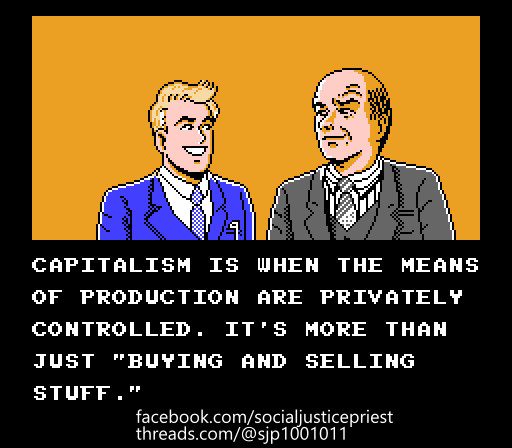
With income inequality continuing to grow and the election of Mayor Mamdani in NYC, we’re hearing more people talk about capitalism, socialism, and communism [1][2]. Unfortunately for us, however, few people talking about these economic systems seem to understand what they are. To provide some clear definitions, I will be writing an article about each one. The articles will describe what they are, what they’re not, and how I feel about them. This first article will be about capitalism.
What is capitalism?
Capitalism is the dominant—and some would argue only—economic system in the world today. Capitalism is a system where the means of production (e.g. factories, farms, data centers, software, etc.) are privately controlled by either an individual, a group, another private entity, or a government (more on this one later). Most of the time, the purpose is making money/a profit. Non-profit organizations can exist under capitalism, but they are still privately controlled. The difference is they must prove they didn’t make any money when it’s time to do their taxes. (The wealthy in the US often use non-profit organizations to avoid taxes, but that’s for another article.)
The most prevalent example of a capitalist organization is a company. A company is a (usually) for-profit entity owned by one or more people. Companies are legally defined entities and come in various shapes, sizes, and types, depending on the state or country it’s located. In the United States, for example, companies can be classified as sole proprietorships, partnerships, S-crops, or C-corps. (Limited Liability Companies (LLCs) also exist, but the laws governing them vary by state because the federal government doesn’t have an official designation for them.) The company owns and uses its available means of production to create goods and/or services. Assuming there is demand, people pay for those good and/or services. If the company makes more money from people than it spends producing the goods and/or services, the company makes a profit. If it doesn’t, it takes a loss. The company will go out of business if it takes too many losses.
Capitalism is a hierarchical system that must have at least two tiers: owners and workers. Owners control the means of production and workers support the owners with their labor in exchange for some form of compensation. This usually takes the form of a fixed sum of money known as a wage or salary. For example, the owner of a data center company needs people to maintain their servers. They hire a staff of IT personnel to perform this role for them and pay them all $100K/year to do this job. The IT personnel are workers and $100K/year is their wage. If the data center makes $1M/ year and has five people working there, the staff will get their wages, totaling $500K/ year. Assuming there are no other expenses (e.g. facility expenses or taxes), that leaves the owner of the data center company with a profit of $500K for the year. Barring any government regulations stating otherwise, the owner is entitled to all those profits. If the data center company has a good year and makes $2M, the workers still get their $500K, but the owner gets $1.5M. This is how some owners become billionaires while their workers remain poor.
Owners in an industry are usually richer than the workers in that industry. For example, the person who owns the car lot is going to have more money than the person who sells the cars for them. This doesn’t mean workers can’t be rich. A well-paid Hollywood actor is a worker who probably has more money than the owner of a car lot, but they don’t have more money than the media company that hired them. That actor may be a millionaire, but they’re still selling their labor to the owner of the studio (the means of production). This is why I labeled the classes of capitalism as “owners” and “workers” instead of “upper class” and “lower class.” In my opinion, dividing people is lower, middle, and upper classes just adds confusion.
What Isn’t Capitalism?
Capitalism isn’t just “buying and selling stuff.” While buying and selling goods and services are important parts of capitalism, they aren’t exclusive to capitalism. For example, both Feudalism and Mercantilism included buying and selling goods and services. Capitalism isn’t defined by markets, it’s defined by ownership. This brings me to my next point.
Capitalism doesn’t require a free market. A free market is defined in the dictionary as “an economic system in which prices are determined by unrestricted competition between privately owned businesses” [3]. Frankly, this doesn’t exist. Government regulations, monopolies, power dynamics, international relations, existing wealth, natural resources, human capital, physical capital, labor, and many other variables can impact a country’s ability to compete with other nations. The same can be said about competition among people within the borders of a nation. A person’s options and opportunities greatly impact their ability to compete [4][5]. The free market is an ideal some economists aspire to, but we haven’t achieved it.
Capitalism isn’t synonymous with democracy. Almost every country in existence uses capitalism, including the non-democratic ones. Many countries in the Middle East are example of this. They are capitalist countries, but many are still ruled by kings. All capitalism requires is private control of the means of production and at least two classes: owners and workers. Democracy is not required, which is one reason some billionaires are hostile to democracy [6].
Capitalism doesn’t require private individuals or companies to control the means of production. A state-run in economy can still be capitalist. Private control of the means of production also includes the state when it is privately controlled. This is known as State Capitalism [7]. An example of this is China. While China is a republic, it’s not a democratic republic. The Communist Party of China wasn’t elected, and it decides the direction of the country through the National People’s Congress (NPC). In other words, the state is privately controlled by a group of people. In China, the state controls a large percentage of the country’s industry. Under Mao Zedong, it was almost full control. While China opened some of its industries to markets, the state can decide to tomorrow to stop. Another lesson here is a country can call itself whatever it wants, but it doesn’t make it that label accurate. The countries calling themselves “communist” now are actually practicing State Capitalism.
How do I feel about it?
While Capitalism is better than the systems it replaced, Feudalism and Mercantilism, it’s still a flawed system. The goal of capitalism is to maximize profits for the owners. This means selling the most goods and/or services at the highest prices while reducing expenses as much as possible. When left to its own devices, capitalism leads to people working long hours for very little pay in unsafe working conditions. It also leads to environmental degradation in the form of pollution and the destruction of natural resources. In some democratic societies, people pushed back against the cruelties of capitalism through direct action (e.g. protests), organizing (e.g. unions), and by enlisting the government (e.g. safety regulations). The most prosperous period for the workers (the white ones, anyway) in America was the 1950s. Union membership was strong, wages were high, housing was affordable, the highest tax rate was 90%, and the government was less beholden to corporate money. In the 1980s, capitalism started to swing in the direction of the owners. This was caused by a decline in union membership, a decline in wages, a lowering of taxes on the rich, and mass deregulations due to increasing corporate influence on the government [8]. The results are people being overworked, underpaid, drowning in debt, and barely being able to afford a roof over their heads [5]. Meanwhile, the owners of the means of production have more wealth than almost any other period in history [2]. While it’s possible to mitigate or reverse many of the problems, there’s nothing keeping them from returning. This is why I believe capitalism has run its course and it’s time for a better system.
What system is that? Socialism.
Sources:
[1] https://www.epi.org/multimedia/unequal-states-of-america/
[2] https://ourworldindata.org/economic-inequality
[3] https://languages.oup.com/google-dictionary-en/
[4] Universal Basic Income by Karl Widerquist
[5] Poverty, by America by Matthew Desmond
[6] https://www.politico.com/magazine/story/2016/11/donald-trump-steve-bannon-peter-thiel-214490/
[7] https://www.britannica.com/topic/state-capitalism
[8] Capital in the Twenty-First Century, film (2019)
The rest comes from the knowledge I’ve acquired through decades of reading, research, and education—including getting an MBA.
Enjoying my content?