

NOTE: I do these book reviews strictly for fun. I am not paid or otherwise compensated by anyone to provide them.
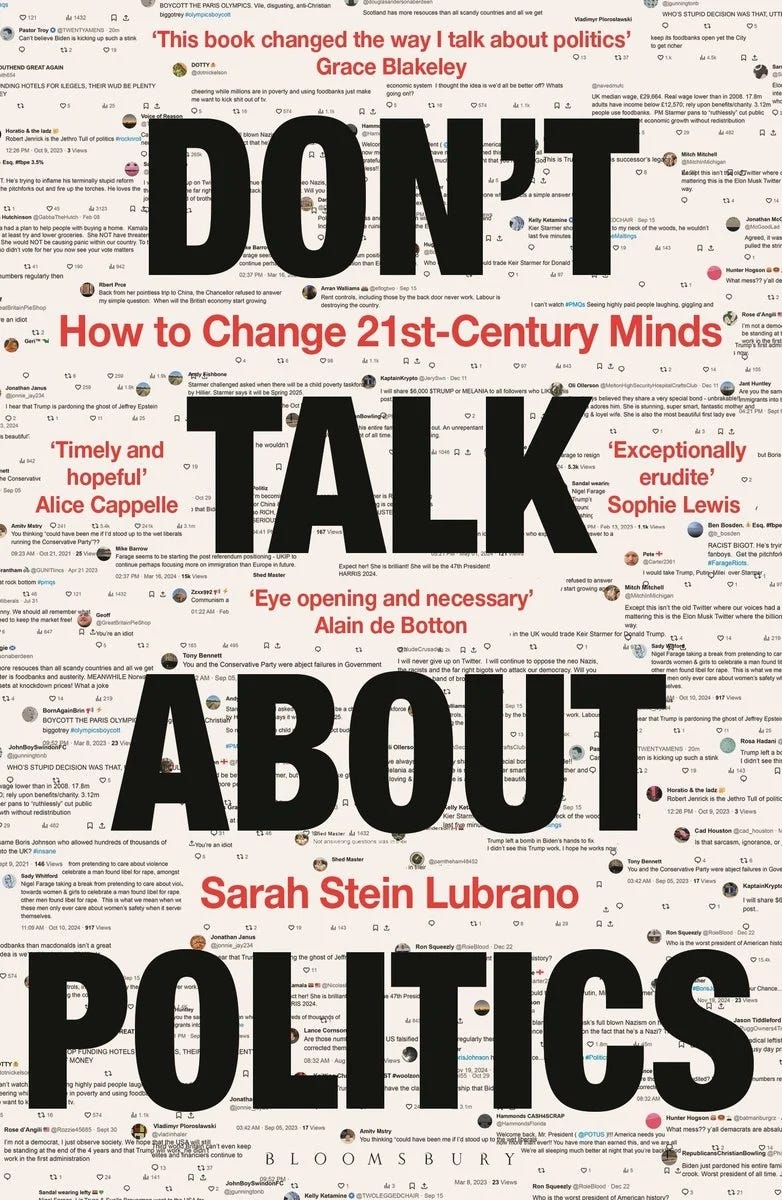
It’s always nice to read a book that ends up confirming what I already suspected to be true (like Nomadland), but this time I got more than I bargained for. They say the truth hurts and this book stung!
Don’t Talk About Politics by Dr. Sarah Stein Lubrano is about changing minds. But it’s not a traditional book about how to persuade people. It’s a book about how humans process information, handle cognitive dissonance, and how the traditional ways of persuading people to change their political views are broken. She discusses what doesn’t work, what does work, and provides suggestions for how we can reorganize society to make it easier for people to adopt new ideas. It’s a short read—just under 250 pages—and packed with many hard truths, but it also leaves a few unanswered questions.
Lubrano’s first two chapters talk about why the “marketplace of ideas” and debate are nonsense.
People who’ve come here from my Facebook know I love to argue/debate. Some people watch sports, I argue with people. I don’t debate subjects like whether gay people have the right to exist (they do). That’s an automatic block because I don’t platform bigots, but I will debate economics and certain other social issues with people all day long. Whether I win or lose, it’s fun for me. This book says I shouldn’t be doing that—and it’s right!
While now I only do it for fun, I used to be a true believer in marketplace of ideas and debate. I believed over time good (more factual) ideas would win out over bad (less factual) ones because people would choose the better ideas voluntarily. I believed if I only argued well enough, people would adopt my ideas because they would see they were closer to truth. Then I got older.
Without going into too many details, I learned very quickly having “good” ideas doesn’t matter because the viability of an idea depends more on what people want to be true and/or confirms what they already believe vs. how true that idea is. “Winning” an argument didn’t mean much because most people (myself including, I’m mature enough to admit) hold on to their beliefs for mostly irrational reasons. In other words, feelings mattered more than facts when it came to accepting new ideas. Multiple books I’ve read over the years confirmed that, and Lubrano took it one step further. Even without our inherent biases, there are multiple obstacles an idea must overcome before it even reaches our ears! I would go into more detail, but I don’t want to spoil what I believe to be one of the best parts of the book!
Lubrano then goes on to argue protests aren’t effective method of political change. Most politicians don’t care about them, and they don’t change the minds of the people who don’t agree with them (most of the time). My first instinct was to argue that the Black Lives Matter protests of 2020 were evidence she was wrong. She anticipated that. Her book showed that while Black Lives Matter protests were very effective at changing people’s opinions, it was the exception and not the rule. As someone who has participated in many protests and advocates for protesting as a means of affecting change, this was a hard lesson for me to learn.
Does that mean protests are pointless? No. Lubrano argued protests are very effective at changing the minds of the people who participate in them. Many of the people who participated in the Black Lives Matter protests in 2020 went on to move into other forms of political activism. Their participation in one event paved the way for them to do other social/racial justice work. So while protests themselves are not effective for changing minds, they help create the next generation of activists who will. This brings me to one of my favorite points Lubrano made: people act first and think later.
Humans hate cognitive dissonance, especially when it comes to something as deeply part of their identity as their political beliefs. What do we do to avoid this cognitive dissonance? Usually change our beliefs to reflect our actions. For example, let’s assume a guy, Bob, is against helping the poor. For one reason or another, he visits a mutual aid station or soup kitchen. His actions cause him to soften his beliefs about helping the poor. It doesn’t matter if he’s a volunteer or a user. He will do whatever it takes to avoid cognitive dissonance. The takeaway? To change someone’s mind, don’t try to argue with them, bring them to protest or a mutual aid station.
Another good point Lubrano made was humans think with their friends. The story of the lone philosopher sitting on top of a mountain and coming back with wisdom is usually just that: a story. While small doses of isolation can help people deal with information overload, that’s not how humans do most of their thinking. Humans are social creatures designed to cooperate. This includes hunting, gathering, working, living, and thinking. We often change our ideas to reflect the groups we are with, and groups frequently evaluate new ideas brought to that group together. Even in the case of the isolated philosopher, they will eventually share their beliefs with other people and collaboratively revise them. That’s because who you live with affects how you think.
People are affected by who they see in their daily lives. Even if they don’t directly interact with those people, simply seeing them around raises their tolerance for them. People who live diverse areas with people of multiple races, religions, beliefs, and sexual orientations are more likely to be tolerant of those people and have beliefs reflecting that. This is another effect of our desire to avoid cognitive dissonance. It’s hard to keep believing Muslims are dangerous if the woman you buy apples from at the farmer’s market every couple of weeks is a Muslim. This is why many of the most racist people are ones who live in communities with only members of their same race. Lubrano connects this to one another one of her points: isolation is dangerous.
It’s no secret that capitalism is isolating us from each other. Most of us are overworked, underpaid, leaving us too exhausted to do anything when we get home. The few of us who still want to go out find ourselves with fewer third spaces available to meet and interact with other people. Parks, libraries, and civic centers have been replaced with bars, clubs, and other places we need to pay to access. Lubrano argues this is dangerous.
According to Lubrano’s research, isolation is horrible for humans. Not only does it make us more miserable (at first), it makes us more sensitive. The enhanced sensitivity makes us worry about and dread social interactions and causes us to take events personally when they may have nothing to do with us. It increases our paranoia and makes us distrust other human beings, which leads directly to adopting reactionary views. Even worse, prolonged isolation makes us no longer feel like we need other people so we stop trying. Despite no longer feeling the pain of loneliness, isolation will still continue to damage us. Isolation literally shrinks our brains, specifically the parts use for social interaction. This, in my opinion and hers, is what’s most dangerous about isolation.
Two topics I felt Lubrano could’ve done a better job covering were the spectrum of allies and deep canvassing.
The spectrum of allies is the idea that everyone you meet exists on a scale from “strongly aligned” to “strongly opposed.” Lubrano asserted the people you have the best chance of convincing just by exposing them to ideas are “weakly aligned” or “neutral” to your position. As someone who has learned this through almost thirty years of experience, I would have liked to hear more about the political theories and research surrounding this idea.
Deep canvassing was the other hard truth for me. It’s the way you reach people on the opposite end of the spectrum of allies. Deep canvassing is when you knock on someone’s door and instead of handing out fliers or talking briefly about a political candidate, you sit them for a long time (at least thirty minutes) and have a conversation about a political issue. To summarize an example Lubrano used in the book, two people visit the house of someone who has bigoted views against trans people. The two people sit down and have a conversation about why the person is hostile to trans people and towards the end of the conversation, one person, who happens to be trans, asks, “Well, I’m trans. Do you still feel that way about trans people?” Sounds ridiculous, right? Well it works! Most of the time this causes people to soften their stance. Why is this a hard truth? Because this is what Daryl Davis does with KKK members, and those who have read my other article know how I feel about him. Deep canvassing being effective means Daryl Davis’s methods are more effective than I would like to believe.
Does that mean we all need to start talking to KKK members? No! Lubrano stated although deep canvassing was effective at the individual level, it was time-consuming and people were still studying its long-term impact. Indeed, at least one of the people Daryl Davis “converted” was arrested for shooting at counterprotesters at the “Unite the Right” rally in Charlottesville. While I understand deep canvassing was still being researched, I would’ve liked to learn about its second and third order consequences.
While I understand the main point of Lubrano’s book was trying to win people over with arguments is inefficient at best, I still would’ve liked to learn more about the above concepts.
My main disappointment with her book was Lubrano’s failure to mention how racism played a big role in the disappearance of public third spaces—especially in the South. While I understand this wasn’t the case for most other democratic nations, the focus of her book was the US. In the US the main reasons third spaces started disappearing was because white people refused to integrate. That’s the reason public pools disappeared from the South, for example. In the north this took the form of Black people being confined to neighborhood with low-quality housing and very little funding for public spaces like parks. Lubrano correctly points out the reduction in both third spaces and associations like bowling clubs happened because of the economic crash in the 1970s and the subsequent election of Ronald Reagan. Reagan forced Neoliberalism on the United States, which resulted in the privatization of many public spaces. What Lubrano failed to point out is how Reagan won his election by campaigning on racism (e.g. “welfare queens”).
Last but not least, I want to commend Lubrano for going out of her way to condemn Israel’s genocide of Palestine. During her section about identity, she mentions she is Jewish but she’s also a leftist. She talks about her willingness to speak out against what Israel is doing to the Palestinians creates friction between her and some of the Jewish people in her community. Overall point of the segment was to discuss how identity isn’t best way to form associations that are conducive to adopting new ideas. In my opinion, she could’ve done this perfectly without talking about what Israel did to Palestine. There were multiple other examples she could’ve used, but she chose that one. When I read this book in the spring of 2026, public opinion had thankfully shifted in favor of Palestine. She couldn’t have known that when she published the book in mid-2024. She stood up for what she believed was right even though it meant taking a risk. I respect that!
I give Don’t Talk About Politics by Dr. Sarah Stein Lubrano an 8.5/10. The book is a great read, and I’m not just saying that because the first few chapters confirmed what I already believed. It delivers many well-researched hard truths and Lubrano both cites her sources and provides a list of material for “further reading.” The book loses a point for not discussing how racism led to the erosion of the third space—and could very well again if we’re not careful. The other half-point lost is because I felt like there were some good topics she just left hanging. At less than 250 pages, this is still a must read for those who wish to understand why changing minds is about building better systems instead of making better arguments.
Enjoying my content?