

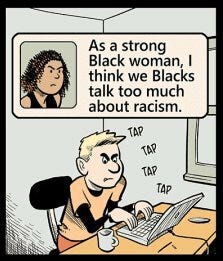
Digital Blackface is when non-Black people pretend to be Black online. They do this in the form of using Black reaction gifs, taking a black avatar, using (or more often misusing) African American Vernacular English (AAVE), and/or claiming they’re a Black person for the purpose of deceiving others. This is usually done for personal, financial, and/or political gain.
Digital Blackface is different from Blackfishing, which is when a white person pretends to be Black in real life for the sake of personal, financial, and/or political gain. The most well-known example of Blackfishing is Rachel Dolezal, who spent a portion of her life darkening her skin and pretending she was a Black woman. Additionally, Digital Blackface can be a one time deal while Blackfishing usually requires more commitment. You can’t go to work as a “Black” woman and Tuesday, come back on Wednesday as a white woman, and go back to being a “Black” woman on Thursday.
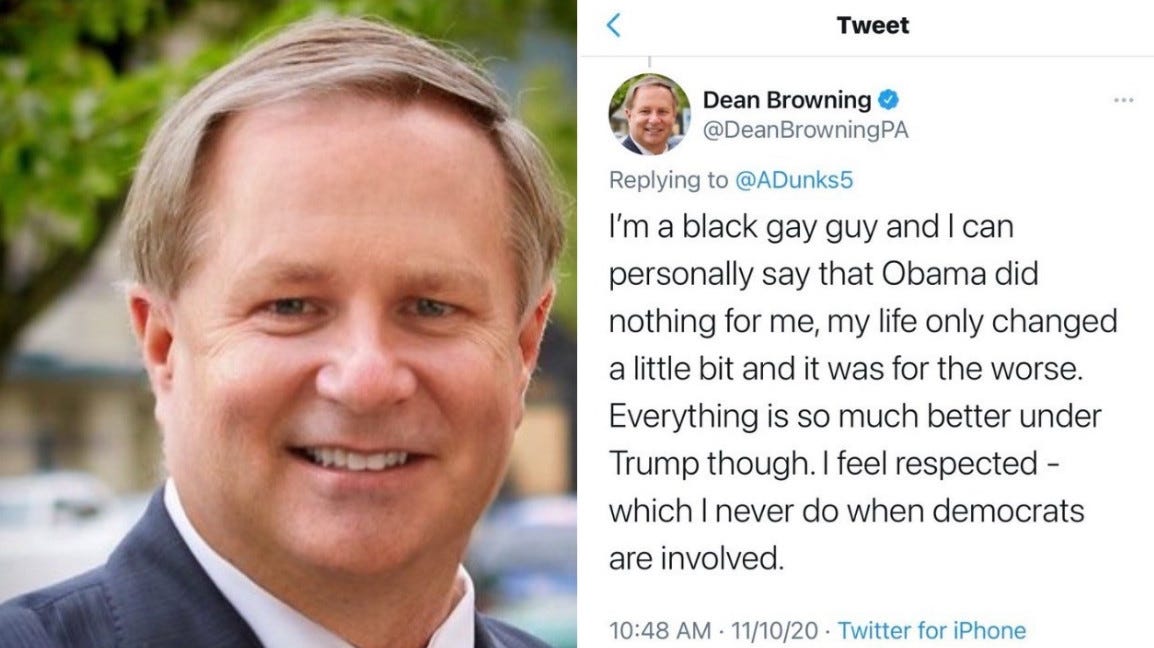
Right-wingers will use Digital Blackface to try and sway the opinions of real Black people or provide cover for themselves. One common example is for people to use their “Black” account to defend themselves from accusations of racism or to make their positions seem more popular with Black people than they are. Two famous examples of this were Dean Browning, a politician running for state senate in Pennsylvania (posted below), and Charlie Kirk. Both forgot to sign into their “Black” accounts before posting tweets agreeing with themselves.
Digital Blackface is one of the many reasons why I don’t believe most of the things right-wingers tell me—regardless of race!
Enjoying my content?